


After Action Review: Four Questions and Ready Templates for Ops Teams

An after action review is a short, structured, blameless team session that turns what just happened, good or bad, into specific, assigned, time-bound improvements. Its purpose is not to assign fault but to convert raw observation into decisions your team will actually implement. In practice, that means running a quick debrief within hours of a routine event or scheduling a full review when the stakes and complexity warrant deeper analysis.
TL;DR:
Short debriefs should be conducted immediately after routine events to ensure details remain fresh and insights are most accurate.
Full AARs are necessary for complex incidents or milestones involving multiple teams, with evidence validation and expert input critical before finalizing findings.
Effectiveness depends on clear, specific recommendations with assigned owners, due dates, and measurable verification steps, prioritizing high impact items first.
Facilitators should focus on factual observations, avoid blame language, and rotate note-taking roles to encourage candor and full participation.
Using structured templates and external facilitators increases the likelihood that actions from AARs are remembered, owned, and implemented effectively.
PROJECT-JTH
Bring More Clarity Under Pressure
PROJECT-JTH helps teams address operational challenges through technical advisory services, leadership training, and practical communication strategies.
Table of Contents
How Do You Turn Observations Into Actions That Actually Get Done?
What Kills an After Action Review, and How Do You Prevent It?
PROJECT-JTH’s Perspective on Running AARs That Actually Stick
Get a Facilitator, Template, or Workshop for Your Next Review
When Should You Run an After Action Review?
Not every event needs the same treatment. A rapid debrief typically takes a short amount of time and fits routine operations, small projects, or daily standups where memory is fresh and stakes are low. A full AAR is longer, suited to significant incidents, project milestones, or events involving multiple teams and outside data. For complex or high-visibility incidents, FEMA’s guidance recommends producing a Quick-Look Report (QLR) promptly to give leaders immediate priorities, and followed by a fuller after action report once analysis is complete.
Timing matters as much as format:
Run short debriefs immediately, while details are still sharp in people’s minds.
Reserve full AARs for events needing data collection, subject-matter expert input, or cross-team coordination.
Scope the invite list to people with direct knowledge of the event, plus one facilitator who was not personally responsible for the outcome.
Escalate to a formal briefing or written report when leadership or external stakeholders need documented findings.
What Are the Four Core AAR Questions?
Every effective after action review, regardless of sector, centers on four questions. What was the intended outcome? What actually happened? Why did a difference occur? What will we change next time? These four questions form the backbone of the AAR method as described by BetterEvaluation, and the way a facilitator phrases them determines whether people answer honestly or defensively.
Good facilitator prompts keep the focus on events, not people:
For intent: “What did we expect to happen, and what did success look like on paper?”
For actual outcome: “Walk me through what you observed step by step. No interpretation yet, just what happened.”
For the gap: “What conditions, decisions, or resources explain the difference between plan and reality?”
For next actions: “If we ran this again tomorrow, what is the one thing we would do differently?”
A vague answer like “communication broke down” is not useful. A facilitator should push for specifics: who needed the information, when, and through what channel it failed to arrive.
How Do You Run a Full After Action Review Step by Step?
A full AAR follows a repeatable sequence. Skipping steps, especially validation, is why many reviews produce notes nobody acts on.
Prepare. Define the scope, name a neutral facilitator, gather relevant data (timelines, metrics, incident logs), and invite people with firsthand knowledge.
Open the session. State ground rules explicitly: no blame, focus on facts, everyone contributes. Two minutes is enough.
Work through the four questions. Timebox each one, generally 10 to 20 minutes depending on session length, and capture responses as they’re spoken rather than paraphrasing later.
Collect evidence. Cross-check verbal accounts against logs, metrics, or documents where available; discrepancies often surface the most useful lessons.
Validate observations. Route draft findings to subject-matter experts who weren’t in the room, a step FEMA’s process treats as essential before publishing any AAR product.
Run an Action Planning Workshop (APW). A short follow-up session, separate from the AAR itself, where owners and deadlines get finalized for each recommendation.
Publish and distribute. Share the AAR, QLR, or briefing with stakeholders who need to act on it.
Pro Tip: Rotate the note-taker role each session. A facilitator who is also scribbling notes will miss the moment when someone hesitates before answering, which is usually when the real story is about to come out.
Copy-Paste Templates for Your Next AAR
You don’t need special software to run a good review. A shared document with the right fields does the job.
Rapid debrief agenda with a short duration:
Ground rules (2 min)
What was intended, what happened (10 min)
Why the gap, what changes (10 min)
Assign one to three actions with owners (5 min)
Standard AAR agenda designed to take a moderate interval:
Ground rules and scope (5 min)
Intended outcome discussion (10 min)
Actual outcome walkthrough with evidence (20 min)
Root-cause discussion on differences (20 min)
Draft action recommendations (15 min)
Wrap-up and next steps, including APW scheduling (10 min)
Note-taking fields: time, topic, observation, supporting evidence, preliminary recommended action.
Action-plan tracker fields: observation, recommended action, owner, due date, verification metric, status. The WHO’s after action review toolkit offers a similar structure adaptable for hybrid or remote sessions.
How Do You Turn Observations Into Actions That Actually Get Done?
The gap between a good AAR and a wasted one comes down to specificity. “Improve communication” changes nothing. “Implement a five-minute daily sync at 09:00 for the remainder of the project, owned by the project lead” changes behavior, an example of the kind of rewrite BetterEvaluation recommends when converting findings into recommendations.
Use a rubric before any item leaves the room:
Is the action specific enough that two people would implement it the same way?
Does it have a single named owner, not a department or team?
Does it have a due date and a way to verify it happened?
Prioritize by impact times effort. High-impact, low-effort items go first.
Action plans that skip the verification step rarely survive contact with a busy calendar. FEMA’s guidance notes that recommendations need a measurable way to confirm success, not just a due date, or most never get implemented. Set a review cadence, weekly for active projects, monthly for longer initiatives, and escalate any high-impact item that slips past its deadline twice.
What Kills an After Action Review, and How Do You Prevent It?
The most common failure mode is blame creeping into the conversation. The moment someone feels accused, the room stops sharing anything candid, and the rest of the session becomes theater. A second failure is vague recommendations that read well in a document but describe nothing anyone can execute. A third is skipping subject-matter expert validation, which lets flawed assumptions get published as findings. A fourth, and probably the most common in practice, is simply never following up: the notes get filed and nobody checks the action items again.
Facilitators can prevent most of this with language choices. Requiring statements to be framed as “what I observed” or “what I did,” rather than naming who was at fault, measurably increases candid participation according to Wharton’s research on the format. Rotate who takes notes, restate ground rules at the start of every session, and never let a session end without owners attached to every action.
Ground rule: no names attached to problems, only conditions and decisions.
Ground rule: every recommendation gets an owner and a date before the meeting ends.
Ground rule: silence is not agreement, so ask quieter participants directly.
Pro Tip: If a recommendation doesn’t have both an owner and a way to verify it happened, cut it from the list entirely. A recommendation without accountability isn’t a plan, it’s a wish.
How Do You Get Full Participation From Every Team Member?
An AAR with one person talking and everyone else nodding is not a review, it’s a monologue. Getting honest input from a full room, especially one with mixed seniority, takes deliberate structure rather than hope.
Start by asking the most junior or least senior person in the room to speak first on each question. Once a manager gives their take, everyone else tends to agree with it, whether or not they actually do. Reversing the order breaks that pattern.
Written input works alongside verbal discussion, not instead of it. Some participants, particularly those newer to the team or less comfortable speaking up in groups, will write a sharper observation on a sticky note or shared document than they’ll say out loud. Collecting a few written notes before the open discussion starts often surfaces details the group conversation misses entirely.

Keep the facilitator role separate from the person who ran the event being reviewed. Someone reviewing their own decisions, even with the best intentions, tends to explain rather than observe. A neutral facilitator, whether an internal peer from another team or an outside consultant, can ask the uncomfortable follow-up question without the session turning defensive.
Finally, close every AAR by reading the action items back aloud with names and dates attached. This single step does more for participation in the next AAR than almost anything else, because it proves the first one led somewhere.
How Does an AAR Differ From a Retrospective or Postmortem?
An after action review, a sprint retrospective, and a blameless postmortem share the same DNA: structured reflection, a defined set of questions, and a bias toward specific next steps. The differences are in scope and timing.
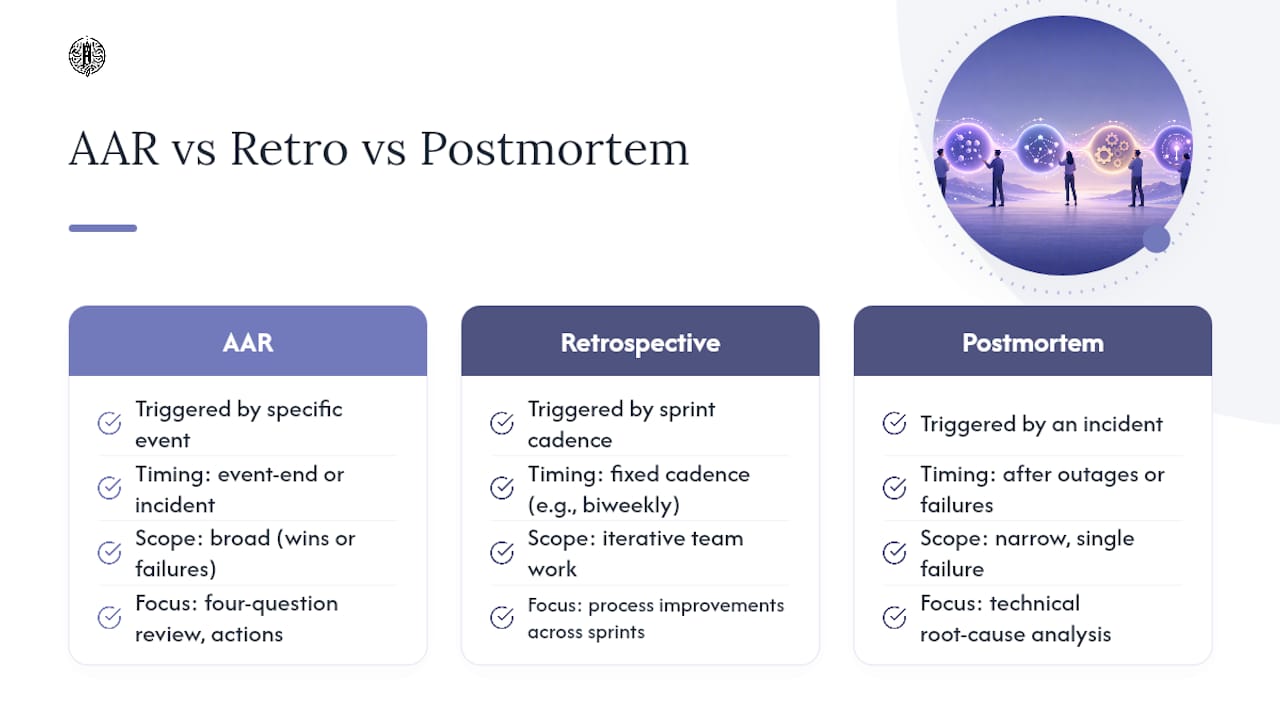
A retrospective, common in software teams running iterative sprints, typically happens on a fixed cadence (every two weeks, for instance) regardless of whether anything went wrong. An AAR is event-triggered. It happens because something specific occurred, a project phase ended, an incident occurred, an operation concluded, whether the outcome was good or bad.
A postmortem, meanwhile, is usually reserved for incidents: outages, failures, near-misses. Blameless postmortem practice in engineering organizations borrows heavily from the same psychological-safety principles that make AARs work, framing statements around systems and conditions rather than individual fault. Where a postmortem tends to focus narrowly on a single failure and its technical root cause, an AAR’s four-question structure applies equally to a clean success story, which is worth remembering since reflecting on wins helps teams repeat what worked rather than only fixing what didn’t.
In practice, the tools overlap enough that a team using AAR-style facilitation and calling it a “retro” or a “postmortem review” is not doing anything wrong. What matters is the discipline underneath the label: specific observations, assigned actions, and a verification step.
Where Do After Action Reviews Deliver the Most Value?
The military originated the modern AAR format, and it remains a fixture in training and operational debriefs precisely because decisions there often happen under incomplete information and real time pressure. That same profile, high stakes, incomplete data, fast decisions, is exactly why the format transfers so well beyond its origin.
Healthcare teams use structured after-incident reviews following adverse events or near-misses, often adapting frameworks like the one in the WHO’s after action review toolkit, built originally for public-health emergency response. Law enforcement and public safety agencies rely on AARs for both critical incidents and routine operations. The COPS Office guidance from the Department of Justice frames these reviews as forward-looking tools meant to feed directly into training curricula and policy updates, not just paperwork.
In business, AARs show up wherever teams make consequential calls with imperfect information: product launches, incident response in technology operations, construction and field-service projects, live event production. Any environment where a team must make a decision under uncertainty, then live with the consequences before the full picture is available, benefits from a structured way to close the loop afterward. The common thread across every sector isn’t the industry itself, it’s the presence of a decision that mattered, made without perfect visibility, followed by a result worth understanding.
PROJECT-JTH’s Perspective on Running AARs That Actually Stick
Most AARs fail quietly. Nobody skips the meeting, they just let the facilitator soften every hard question until the notes say nothing useful. Some organizations build their approach around facilitated, data-focused reviews precisely because leaders need someone in the room who isn’t invested in a flattering outcome. External facilitation can be especially valuable on high-stakes reviews, security incidents, mission-critical operations, projects with client exposure, where internal politics make candor expensive. Teams using structured records to track production and contract history walk into the review with facts already assembled instead of competing memories, which changes the whole tone of the conversation.
— Jesse Hart
Get a Facilitator, Template, or Workshop for Your Next Review
Reading about the four questions is one thing. Running a review where a defensive stakeholder won’t derail the conversation is another. Organizations may bring in a neutral facilitator with experience running sessions under operational pressure, obtain leadership workshops to train teams to facilitate future reviews, or adopt tools to keep production and decision records organized before the next review even starts.
If your last few post-incident reviews produced action items nobody remembers, that’s a facilitation problem, not a team problem. Visit PROJECT-JTH to book a consultation, request a facilitator for your next high-stakes review, or ask about a copy of our AAR agenda and action-tracker templates. For teams building out their own documentation workflow around review outputs, resources like AI-assisted productivity workflows can help keep those records organized between sessions.
Where to Find Official AAR Templates and Guidance
FEMA’s After-Action Review User Guide lays out the full eight-step federal process, including AAR and QLR product templates. The COPS Office guidance covers law-enforcement-specific facilitation practices. BetterEvaluation’s AAR method page offers concise facilitator prompts and common pitfalls. The WHO toolkit provides templates suited to hybrid and remote formats.
Sources
FAQ
What Are the Four Steps of an AAR?
The four steps are asking what was intended, what actually happened, why any difference occurred, and what the team will change next time, run in that order during a single facilitated session.
What Are the Four Questions Asked in an AAR?
They are: What did we intend to happen? What actually happened? Why was there a difference? What will we do differently next time? These questions structure every AAR regardless of sector.
What Should Be Included in an After Action Review?
A complete AAR includes ground rules for blameless discussion, answers to the four core questions backed by evidence, and a set of specific, owned, time-bound action items with a verification method, ideally finalized in a follow-up Action Planning Workshop.
What’s Another Word for After Action Review?
Common alternatives include after action report, post-incident review, lessons learned review, or blameless postmortem, though each carries slightly different sector conventions around timing and scope.
How Long Should an After Action Review Take?
A rapid debrief runs a short amount of time for routine events, while a full AAR is longer, suited to significant incidents or projects requiring evidence review and stakeholder input.
