


3 Audit Ready Items From Vendor Risk Assessments for Risk Managers
A vendor risk assessment is the process of evaluating a third party’s cybersecurity, financial, operational, compliance, and reputational exposure before and during a business relationship. Done correctly, it produces exactly three artifacts: a residual risk score, a written accept, mitigate, or reject decision record (decision record), and a risk-register entry naming an owner and a review date. Run it at onboarding, at renewal, whenever vendor scope changes, and after any incident touching that vendor’s systems.
TL;DR:
Vendor risk assessments should be conducted at onboarding, renewal, scope changes, after incidents, and during monitoring alerts, with critical vendors requiring more frequent reviews.
An effective program must produce a residual risk score, a clear decision record, and a risk-register entry with an owner and review date, or it risks losing its defensibility.
Scoring across five domains—cybersecurity, financial, operational, compliance, and reputational risk—must be justified with evidence and weighted by business importance.
Use standardized questionnaires like SIG Lite or CAIQ for efficiency, focusing evidence requests on minimal, relevant evidence such as current SOC 2 reports and contractual attestations.
Red flags for escalation include missing or outdated compliance evidence, lack of insurance, undisclosed subprocessors, uncontrolled privileged access, or recent incident history.
Projectjth
Bring Clarity to Operational Risk
Projectjth provides technical advisory services and risk assessments for companies managing cybersecurity and operational challenges.
Table of Contents
Five-Step Vendor Risk Assessment Process You Can Implement Today
Which Questionnaires and Evidence Actually Reduce Vendor Fatigue?
Implementation Notes From Projectjth on Assessments Under Pressure
A Practical Checklist and the Red Flags That Demand Escalation
How Projectjth Helps You Build a Working Vendor Risk Program
What Is a Vendor Risk Assessment, and Why Does It Matter?
A vendor risk assessment is a structured evaluation of the exposure a third party introduces to your operations, data, and finances, converted into a documented decision. That distinguishes it from vendor due diligence, which is typically a one-time check performed before signing a contract. An assessment is repeated, scored, and tied to a governance cycle, not a single gate at intake.
Regulators and boards care about this distinction because accountability for third-party failures sits with the hiring organization, not the vendor. NIST SP 800-66 Revision 2 treats risk analysis as foundational to HIPAA security compliance and expects the frequency of that analysis to match your organization’s size, complexity, and threat environment, not a fixed annual box you check. Gartner’s research on third-party risk management makes a similar point: as vendor networks grow more layered, boards increasingly expect centralized oversight rather than scattered, department-level checks.
A defensible program produces:
A documented risk score per domain, with a short written justification
An explicit decision, not a silent approval
A named owner and a scheduled review date, entered into a risk register
Skip any of these three, and the assessment exists only as a memory, which auditors treat as if it never happened.
When Should You Run a Vendor Risk Assessment?
Vendor risk doesn’t stay fixed after signing a contract, and neither should your assessment cadence. Five triggers cover nearly every real-world scenario:
Onboarding. Before any data access or system integration begins.
Contract renewal. Especially when pricing, scope, or subprocessors have shifted since the last cycle.
Scope changes. A vendor gaining new data access or a new integration point resets the clock.
Vendor incidents. A breach, outage, or public disclosure at the vendor triggers an out-of-cycle review.
Monitoring alerts. Continuous signals (falling cyber ratings, lapsed certifications) can force an early reassessment.
Leading guides converge on this same six-trigger structure, and cadence should scale with tier. Critical vendors handling regulated data warrant regular full reviews at minimum, with light-touch checks periodically. Low-tier vendors, think office supply or non-data-touching services, can run on a two- or three-year cycle unless a trigger fires early.
Five-Step Vendor Risk Assessment Process You Can Implement Today
Most vendor risk programs collapse under their own paperwork, not under actual risk. The fix is a tight five-step sequence with a clear exit artifact at each stage.
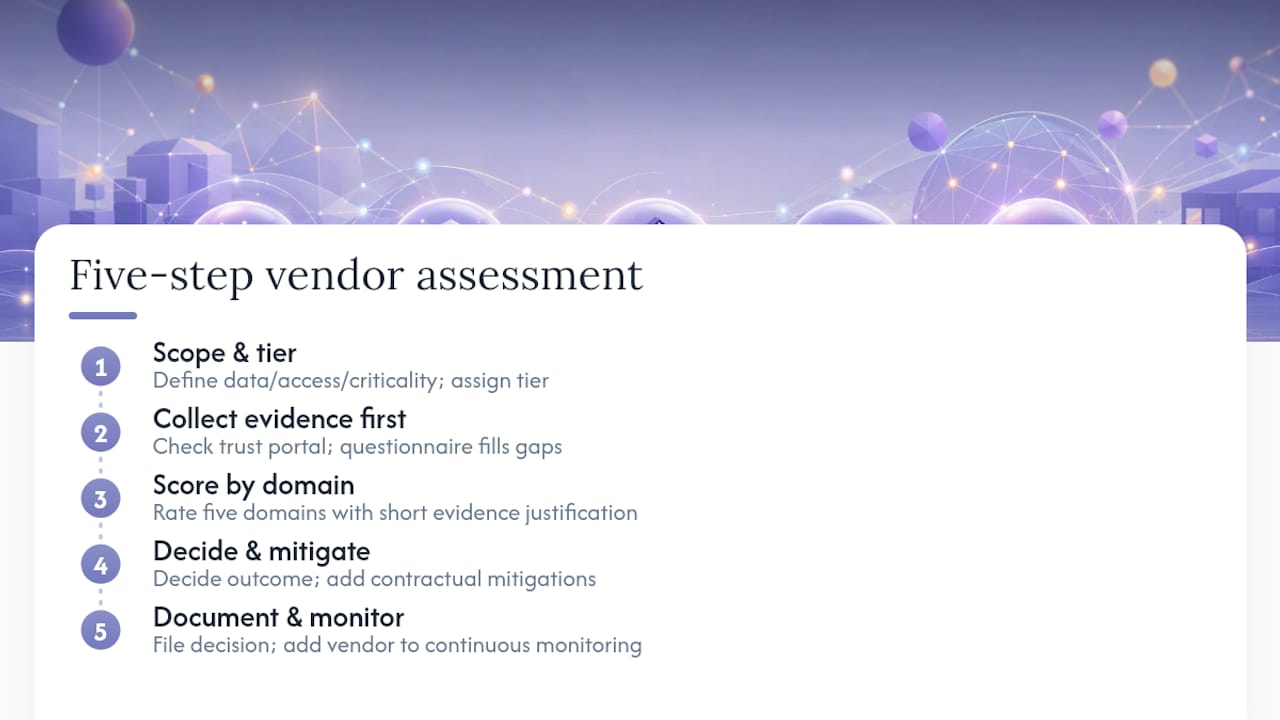
Step 1: Scope and tier the vendor. Before any evidence request goes out, define what the vendor touches: data classification, system access level, and business criticality. A procurement lead or risk manager should own this call, and the exit artifact is a single tier assignment (critical, high, medium, or low) that determines everything downstream.
Step 2: Collect evidence, starting with trust portals. Check the vendor’s existing trust portal or public compliance page first. Many mid-size and enterprise vendors already publish SOC 2 reports, ISO certifications, and penetration test summaries there. Send a questionnaire only to fill the gaps a trust portal doesn’t cover. This ordering alone cuts the back-and-forth that turns a two-week assessment into a two-month one, since evidence-first programs reduce vendor friction compared to questionnaire-first approaches.
Step 3: Score by domain with a short justification. Rate cybersecurity, financial, operational, compliance, and reputational risk independently. Each score needs one or two sentences of justification tied to actual evidence, not a gut feeling. “Medium cyber risk, SOC 2 Type II current but no evidence of tabletop exercises” is defensible. “Medium” alone is not.
Step 4: Decide, and attach contractual mitigations. Three outcomes exist: accept, accept with mitigation, or reject. Mitigations belong in the contract itself, breach notification windows, right-to-audit clauses, insurance minimums, not in a side email that disappears from institutional memory.
Step 5: Document and enroll in monitoring. File the decision record and risk-register entry, then add the vendor to your continuous monitoring feed so the next trigger surfaces automatically instead of depending on someone remembering a renewal date.
Pro Tip: Build your evidence request around what you’ll actually read. A 150-question SIG Full questionnaire that sits unopened in a shared drive protects nobody. A tight evidence packet mapped directly to your five scoring domains gets reviewed the same week it arrives.
How Do You Score Risk Across the Five Domains?
Vendor risk breaks down into five domains that most established frameworks treat as the core coverage set:
Cybersecurity risk: evaluated through SOC 2 reports, penetration test summaries, and evidence of privileged access controls when the vendor will hold admin-level credentials.
Financial risk: assessed through credit reports, funding stability, and concentration risk if the vendor is a small firm serving one dominant client.
Operational risk: judged by uptime history, disaster recovery plans, and subcontractor dependency chains.
Compliance risk: measured against relevant regulatory frameworks, HIPAA, GDPR, or sector-specific rules, depending on the data involved.
Reputational risk: gauged through litigation history, public breach disclosures, and media coverage patterns.
A Low/Medium/High qualitative scale works for most vendors, but high-risk items need a quantitative anchor underneath the label. “High cyber risk” should point to something concrete: no current SOC 2, privileged access without documented incident response capability, or a breach in the past 18 months.
Weighting matters as much as scoring. A vendor touching regulated health data should weight compliance and cybersecurity heavier than a vendor supplying office furniture, even if both receive identical “Medium” operational scores. Ncontracts’ guide to third-party risk frames this correctly: the residual score that lands in your decision record should reflect business criticality, not a flat average across five equally weighted boxes.
Which Questionnaires and Evidence Actually Reduce Vendor Fatigue?
Standardized questionnaires exist so you’re not reinventing evaluation criteria for every vendor. SIG Lite works well for medium-tier vendors where a condensed set of questions covers the essentials without demanding a full security team’s time to complete. CAIQ (Consensus Assessments Initiative Questionnaire) fits cloud service providers specifically, since it maps directly to cloud control domains. For low-tier vendors, a bespoke five-question form often beats either standard template.
CISA’s vendor template for SMBs demonstrates a useful shortcut: threshold yes/no questions that route straightforward cases past a full questionnaire entirely, reserving deeper review for vendors that fail a threshold check.
For each domain, ask for the minimum evidence that actually answers the question:
Cybersecurity: current SOC 2 Type II or ISO 27001 certificate
Financial: recent financial statement or D&B report for critical vendors only
Compliance: signed Data Processing Agreement (DPA) and any relevant regulatory attestations
Operational: uptime SLA history and a named disaster recovery contact
Trust portals should satisfy most of this before you ever send a form.
How Should You Tier Vendors and Set Assessment Frequency?
Tiering exists to protect your team’s time. Without it, every vendor gets the same 40-hour review, and your highest-risk vendors get the same shallow attention as your lowest.
Critical tier: vendors with privileged system access or regulated data exposure. Full manual assessment annually, quarterly monitoring check-ins, and executive sign-off on the decision record.
High tier: vendors touching sensitive but non-regulated data. Full assessment every 18 to 24 months with automated monitoring between cycles.
Medium tier: vendors with limited data access. Streamlined questionnaire review every two to three years.
Low tier: vendors with no data access, office supplies, facilities services. Threshold questions only, automated renewal unless a trigger fires.
Automate renewal reminders and evidence refresh requests for medium and low tiers. Reserve manual analyst time for critical and high tiers, where a rubber-stamped renewal is exactly the failure mode auditors flag first.
What Belongs in the Decision Record and Risk Register?
An assessment that never gets written down might as well not have happened. Auditors and examiners look for a specific, minimal field set, not a narrative essay.
Vendor ID and business unit sponsor
Scope of access or data involved
Evidence list reviewed, with dates
Domain scores and one-sentence justification for each
Final decision (accept, accept with mitigation, reject) and the name of the person who made it
Mitigations attached, with contractual clause references where applicable
Review cadence and next scheduled date
An “accept with mitigation” record needs one more thing: the specific contractual lever that makes the mitigation enforceable, a breach notification clause, an insurance minimum, or a right-to-audit provision written into the contract renewal.
Pro Tip: Hand procurement, legal, and IT a one-page handoff checklist the moment a decision is finalized. Ambiguity about who updates the contract versus who configures access controls is where mitigations quietly die.
What Signals Should Continuous Monitoring Track?
A point-in-time assessment goes stale the day after you file it. Continuous monitoring closes that gap, but only if you tune it to avoid drowning your team in alerts nobody acts on.
High-value signals worth ingesting:
Cyber rating drops from external scoring services
Certificate, certification, or insurance policy expirations
Public breach disclosures naming the vendor
Subprocessor or fourth-party changes disclosed in vendor updates
Route these into your existing ticketing system rather than a separate monitoring dashboard nobody checks. A minor cyber rating dip can trigger an automated re-score using existing evidence. A confirmed breach or a lapsed insurance policy on a critical vendor should trigger full manual reassessment, no exceptions, regardless of how recently the last cycle closed.
Implementation Notes From Projectjth on Assessments Under Pressure
Assessments fail in practice less often from bad frameworks and more from teams drowning in scattered evidence during a renewal deadline. Technical advisory work centers on building compact evidence rooms, a single organized record per vendor instead of a folder tree six layers deep, similar to the principle behind tools like record management applications.
Leadership training matters here too. Getting a business owner to commit to a remediation timeline under deadline pressure requires calm, direct communication, not a 40-page findings report nobody reads. One useful compression technique: reduce a Tier 1 assessment to a single page for executive sign-off, five domain scores, one decision, one mitigation deadline, before the full record goes into the register.
A Practical Checklist and the Red Flags That Demand Escalation
Strip away the frameworks and vendor risk assessment comes down to a short, repeatable checklist: confirm tier, pull trust-portal evidence before sending a questionnaire, score five domains with a justification sentence each, record a decision with a named owner, and set the next review date before closing the file. Copy that sequence for every onboarding and renewal, and most of the program runs itself.
Five red flags should stop that routine cold and escalate to a full manual review: missing or expired SOC 2/ISO evidence, no insurance coverage on a vendor delivering critical services, an unclear or undisclosed subprocessor list, privileged system access with no documented incident response capability, and any repeated incident history in the past two years.
None of this works if the goal becomes collecting paperwork instead of making a defensible decision. The paperwork is evidence for a call somebody has to make and sign their name to.
— Jesse
How Projectjth Helps You Build a Working Vendor Risk Program
Projectjth is the practical alternative to building a vendor risk program from scratch with no outside guidance, technical advisory work focused on turning frameworks like the ones above into something your team actually uses under deadline pressure. That means designing a compact evidence room structure, building short decision-record templates that hold up in an audit, and coaching the stakeholder conversations that get a vendor to commit to a remediation deadline instead of a vague promise.

A typical engagement produces a working assessment playbook, a handful of piloted vendor assessments to prove the process, and direct coaching for the risk, compliance, or procurement staff who’ll run it going forward. If your current process depends on one person’s memory of which vendors are overdue, that’s the gap worth closing first. Visit Projectjth to talk through what a pilot engagement would look like for your vendor portfolio.
Primary Templates and Official Guidance to Consult
CISA’s Vendor SCRM Template for threshold-based vendor screening
HHS SRA Tool for HIPAA-aligned vendor tracking
NIST SP 800-66 Rev. 2 for risk-analysis frequency guidance
Sources
FAQ
What Should Be Included in a Vendor Risk Assessment?
A complete assessment includes vendor scope and data access level, evidence collected (SOC reports, certifications, DPAs), scores across five risk domains with justification, a documented accept/mitigate/reject decision, and a risk-register entry with an owner and review date.
What Are the Five Things a Risk Assessment Should Cover?
The five core domains are cybersecurity, financial, operational, compliance, and reputational risk, each scored independently and weighted based on the vendor’s data sensitivity and business criticality.
What Are the Types of Vendor Risk?
Vendor risk generally falls into cybersecurity risk (breach or access exposure), financial risk (vendor instability), operational risk (service disruption), compliance risk (regulatory violations), and reputational risk (association with vendor misconduct or public incidents).
What Is an Example of Vendor Risk Management?
A cloud storage vendor renewing its contract gets reassessed: its SOC 2 report is pulled from its trust portal, its cyber rating is checked for changes, domain scores are updated, and the decision (accept, with a right-to-audit clause added) is logged in the risk register with a one-year review date. Tools like Project Relay can help centralize that record so the next renewal cycle starts from an organized file instead of scattered emails.
How Often Should Vendor Risk Assessments Run?
Frequency should scale with tier: critical vendors need annual full reviews with quarterly monitoring, while low-tier vendors can run on a two- to three-year cycle unless an incident or monitoring alert triggers an earlier check.
