


12–24 Month AI Adoption Roadmap for Leaders, 3–4 Week Readiness First

An AI adoption roadmap is a phased, time-sequenced plan that turns a ranked list of AI use cases into a concrete schedule of what gets built, in what order, by whom, and with which decision gates attached. The structure that holds up across most organizations spans three horizons over 12 to 24 months: prove value, scale what works, then differentiate. The first move is not a pilot. It is a 3 to 4 week readiness assessment that tells you whether your data, platform, and governance can actually support what you are about to promise the board.
TL;DR:
A successful AI roadmap relies on early investment in foundational elements like data inventory, platform decision, governance, and skills before scaling use cases.
Prioritize no more than three horizon-one pilots at once, ensuring each is based on a minimum score of three out of five in business value, feasibility, and data readiness.
Conduct a structured readiness assessment before any pilot to identify gaps, set clear success and failure criteria, and avoid stalling at later stages.
Build governance, monitoring, and responsible AI practices into initial phases rather than retrofitting them after deployment to prevent project failures.
Strict decision gates with measurable metrics are critical, and initiatives should only move forward if they satisfy predefined thresholds at each stage.
PROJECT-JTH
Bring Clarity to AI Adoption
PROJECT-JTH provides technical advisory services and practical communication strategies for leaders managing operational challenges under pressure.
Table of Contents
What Foundations Does an AI Adoption Roadmap Need First?
Most roadmaps do not fail because the algorithm was wrong. They fail because nobody scheduled the plumbing. Gartner’s research on AI roadmaps makes the point directly: scaling AI depends on foundations, meaning strategy, value management, organization, talent, governance, engineering, and data, being funded early rather than treated as cleanup work after a pilot succeeds. Skip that sequencing and the roadmap stalls right at the point where it needs to scale.
Four foundations deserve a line item in horizon one, before a single production use case ships.
Data inventory. Catalog your sources, formats, and quality gaps, and assign an owner to each dataset. Most organizations discover mid-project that no one actually owns the customer record they planned to build on.
Platform decision. Cloud, hybrid, or private infrastructure changes your build timeline by months, not weeks. Decide this before scoping use cases, because it constrains almost every technical choice downstream.
Governance basics. Draft acceptable-use policies, stand up a lightweight review board, and define how violations actually get enforced. A policy nobody enforces is theater.
Skills and champions. Identify champions inside each business unit, launch a baseline literacy program, and decide early which capabilities you build internally versus bring in through a partner.
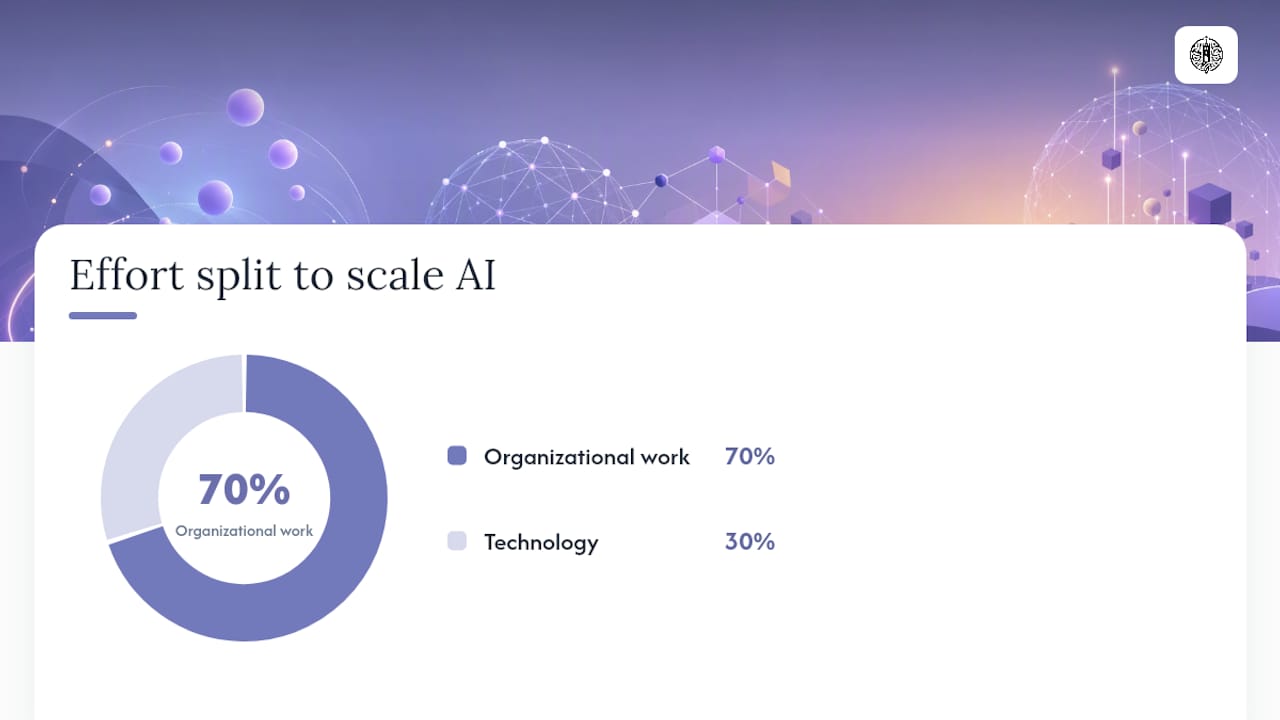
The skills question usually gets underweighted. Gartner’s analysis puts roughly 70% of the effort in scaling AI into organizational work: strategy, talent, governance, and data, with technology accounting for the rest. That ratio should shape your budget, not just your org chart.
Pro Tip: Assign a single accountable owner to the data inventory before you approve any pilot. A pilot built on data nobody owns tends to quietly die when the original champion changes roles.
How Should You Structure the Three Horizons?
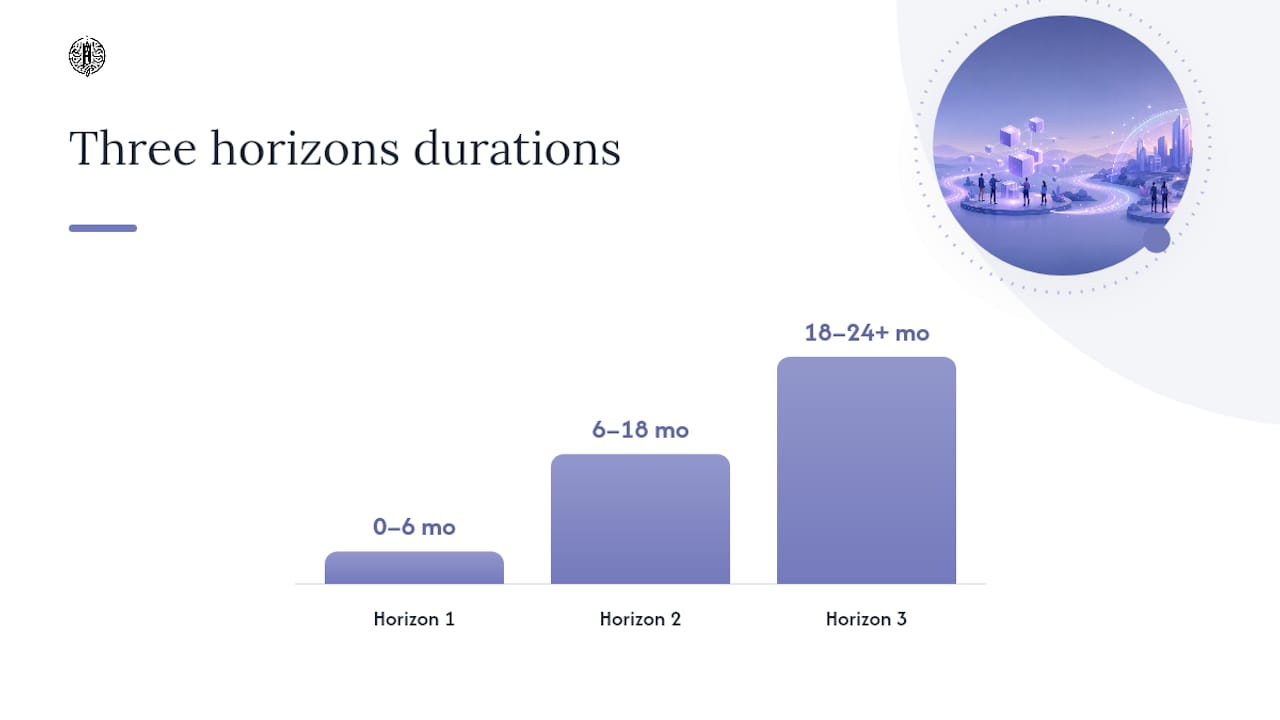
A workable AI implementation roadmap breaks into three horizons, each with a different job and a different definition of success.
Horizon 1, months 0 to 6. Prove value. Run two or three tightly scoped proofs of concept, finish the readiness assessment, and stand up the governance basics. Deliverables here are a validated use case, a working data pipeline, and a go/no go decision on scaling.
Horizon 2, months 6 to 18. Scale what worked. Move validated pilots into production, expand the platform to support higher volume, and formalize the review board into a standing governance function. This horizon consumes the most budget and the most change management effort.
Horizon 3, months 18 to 24 and beyond. Differentiate. Layer AI into processes that create competitive advantage rather than just efficiency, and start treating the platform as core infrastructure rather than a project.
Sequencing rules matter more than the calendar dates. Put quick wins in horizon one, but only the ones that also build reusable foundations. Practitioner guidance on 12 to 24 month roadmaps makes this point well: an early win chosen for its reusable data pipeline or model-serving infrastructure funds horizon two, while a flashy but isolated win funds nothing beyond itself.
Respect team capacity when you schedule. A data science team of four cannot run five parallel pilots and also build the governance board. And schedule shared foundations, the data platform, the identity and access model, the monitoring stack, before the use cases that depend on them, not alongside them. Mapping your prioritized portfolio onto these horizons is mostly an exercise in matching each use case’s dependencies to what will actually exist on the calendar when it needs to launch.
How Do You Prioritize Which AI Use Cases Go First?
Score every candidate use case on three axes: business value, technical feasibility, and data readiness. Keep the scoring fast, a 1 to 5 scale per axis reviewed by a small cross-functional group beats a six-week analysis that goes stale before it finishes.
Business value: revenue impact, cost avoidance, or risk reduction, scored against a common baseline so finance and operations aren’t scoring on different scales.
Technical feasibility: does the required model type exist and work reliably for this problem, or are you building research.
Data readiness: is the data accessible, clean, and governed enough to use without a six-month remediation project first.
CGI’s guidance on building an AI adoption roadmap recommends ranking candidates against exactly these three criteria and selecting two to three horizon-one pilots. That cap is deliberate. More than three pilots running simultaneously in horizon one usually means none of them get the attention needed to produce a clean result.
A practical threshold: only advance a use case to horizon one if it scores at least a 3 out of 5 on all three axes. A brilliant idea with weak data readiness is a horizon-two candidate, not a horizon-one pilot, no matter how much executive enthusiasm it has behind it.
Once proofs of concept land, rescore. A pilot often reveals that feasibility was overestimated or that data quality was worse than the inventory suggested. Treat the scoring model as a living document you revisit after every gate, not a one-time exercise you file away in month one.
How Do You Design a Proof of Concept That Actually Proves Something?
A proof of concept needs hard boundaries before it starts, or it drifts into an open-ended science project. Set the scope in writing: one use case, one business unit, one named owner, and a fixed duration, typically 6 to 10 weeks.
Define the outcome before you start building. Write down what “success” looks like in numbers, not in adjectives.
Assign a single accountable owner who reports the result whether it’s good or bad. Diffuse ownership is how failed pilots quietly become permanent fixtures.
Measure three things: business value delivered against the baseline you set, adoption rate among the actual intended users, and technical reliability under real (not synthetic) conditions.
Bring the result back to the steering group for a launch, continue, or drop decision, using the same scoring rubric you used to select the pilot in the first place.
The Microsoft Cloud Adoption Framework’s AI guidance offers practical checklists for exactly this stage, covering use-case identification, responsible AI checks, and data strategy validation before a pilot graduates to production.
Pro Tip: Write the drop criteria before you write the success criteria. Teams that define failure conditions in advance kill weak pilots faster and with far less internal politics than teams that decide after the fact whether results were “good enough.”
Feed every PoC result, including the failures, back into the prioritization scores for the rest of your portfolio. A failed pilot that reveals a data quality problem is often more valuable to the overall AI adoption plan than a marginal success that teaches you nothing new.
What Governance Do You Need From Day One?
Responsible AI cannot be retrofitted after deployment. The Cloud Adoption Framework is explicit that fairness checks, transparency documentation, and ongoing model monitoring need to be built in from the start of a project, not layered on once something goes wrong in production.
Four governance elements belong on the horizon-one calendar, not the horizon-three one:
A written AI use policy defining what data can feed a model and what decisions a model is allowed to influence.
A review board with real authority to block a launch, not just a rubber-stamp committee.
Named owner roles for each production model, covering monitoring, retraining, and incident response.
Data classification and privacy checks integrated into the same pipeline that feeds your PoCs, not a separate audit that happens later.
Microsoft’s AI Strategy Roadmap research frames governance and security as one of five drivers of successful transformation, alongside business strategy, technology and data, AI experience, and organization and culture. Treat governance as a fifth driver you staff, not a compliance checkbox you address after launch. Integrate it with legal and security early: a governance board that operates separately from the people who already own risk and compliance decisions duplicates work and slows every gate down.
What KPIs and Decision Gates Keep a Roadmap Honest?
A roadmap without measurable gates is just a wish list with dates attached. Build decision gates, launch, continue, or drop, tied to specific metrics, and require a steering committee sign-off at each one rather than letting a single sponsor push a stalled initiative forward on enthusiasm alone.
Track KPIs at two levels:
Portfolio level: total value delivered, number of use cases in each horizon, and overall cost to operate the platform.
Initiative level: business value against baseline, adoption rate among intended users, model accuracy, and system reliability under production load.
Guidance on 12 to 24 month roadmaps recommends attaching launch, continue, or drop gates to measurable success metrics specifically so the roadmap can adapt without losing credibility with the executives funding it. Report to the steering committee monthly during horizon one and quarterly once initiatives reach production, with each gate requiring the PoC or initiative owner to bring actual metrics, not a status update.
What Should Timeline and Budget Actually Look Like?
Most organizations fall into one of three timeline patterns, and the right one depends on how much foundational work already exists.
Fast track (9 to 12 months): viable only when data infrastructure and governance already exist and you’re layering AI onto a mature platform.
Standard (12 to 24 months): the realistic default for most mid-market organizations building foundations and use cases in parallel.
Extended (24 to 36 months): appropriate for heavily regulated industries or organizations starting with fragmented, poorly governed data.
Budget in three categories: the readiness assessment and platform decisions, the PoC and scaling work itself, and ongoing governance staffing. Bring in advisory partners for the assessment and platform architecture decisions, where outside pattern recognition saves months, and hire internally for the roles that need to own systems long term.
What PROJECT-JTH Sees Go Wrong Most Often
The pitfall that shows up most in advisory conversations is not technical. It’s sequencing. Leaders greenlight a horizon-two scaling effort while horizon-one governance is still a slide deck, not a working review process. The fix is boring but reliable: no initiative moves to production until the governance basics it depends on are operating, not just documented.
The second pattern is skipping the readiness assessment entirely and jumping straight to a vendor demo. A structured 3 to 4 week assessment, covering structured interviews, a technology and data landscape scan, and a capability audit, produces a prioritized use-case portfolio, a gap analysis, and a 90-day action plan that materially lowers the risk of the next 18 months. Technical advisory work is often built around that kind of assessment, paired with leadership training that helps teams communicate clearly with each other once the pressure of a live rollout actually hits.
The Roadmap Advice Nobody Wants to Follow
Most AI adoption advice underweights sequencing and overweights vision statements. Executives want to talk about transformation. What actually determines whether a roadmap survives is whether the data pipeline was built before the pilot that depends on it, and whether governance had real teeth before the first model reached production.
The conventional advice treats the readiness assessment as optional, a nice-to-have if there’s time before the “real work” starts. That is backward. Skipping it is the single most common reason roadmaps stall in horizon two, right when the cost of failure is highest and the political capital for a restart is lowest.
If there’s one thing to prioritize above everything else in this article, it’s discipline at the gates. Not enthusiasm, not a slicker pilot demo, not a bigger platform contract. A steering committee willing to actually kill an initiative that misses its metrics is worth more than any framework, three horizons or otherwise. Frameworks don’t fail organizations. The refusal to use decision gates honestly does.
— Jesse Hart
Get Help Building and Running Your Roadmap
An alternative to hiring a large systems integrator for AI roadmap work is a direct advisory relationship where the same people who run the readiness assessment stay involved through the technical build, instead of handing you off to a rotating account team.
The Technical Systems & Risk Review and related technical consulting services map directly onto the readiness assessment and platform decisions covered above, giving you a gap analysis and a concrete 90-day action plan rather than a generic slide deck. For the organizational side, the leadership coaching under Project Praxis helps your champions and steering committee communicate clearly with each other during the pressure points that scaling always creates. And once pilots move toward production, Project Relay gives you a working system for tracking production records and contract details instead of a spreadsheet nobody trusts. Start with a conversation about your readiness assessment at Projectjth.
Sources
For deeper reference, Gartner’s AI roadmap guidance covers the foundational categories leaders need to fund early. Microsoft’s AI Strategy Roadmap lays out the maturity model and five drivers referenced above. The Cloud Adoption Framework offers hands-on checklists for use-case and data strategy work. For content and metrics alignment, the content strategy platform resource is a useful companion when defining success metrics tied to business priorities.
FAQ
What Is the Roadmap for AI Adoption?
An AI adoption roadmap is a phased plan spanning 12 to 24 months that sequences foundational work, data, platform, governance, and skills, ahead of use-case delivery, then moves through three horizons: prove, scale, and differentiate. Each horizon ends with a decision gate that determines whether initiatives continue, scale, or get dropped.
What Is the Framework for AI Adoption?
The most cited framework structures adoption around a maturity assessment paired with five drivers: business strategy, technology and data, AI experience, organization and culture, and governance and security, as outlined in Microsoft’s AI Strategy Roadmap. PROJECT-JTH applies a similar readiness-first approach through its technical consulting engagements, starting with an assessment before any build work begins.
Where Will AI Be in Five Years?
Nobody can state a reliable five-year forecast with confidence, since AI capability and adoption speed have both moved faster than most projections anticipated. What’s more certain is that organizations that build strong data, governance, and skills foundations now will be positioned to adopt new capabilities faster than those still catching up on basics.
Is AI Adoption Slowing Down?
Adoption is not slowing so much as maturing, with organizations shifting from experimental pilots toward disciplined, gated programs that demand measurable value before scaling. That shift toward rigor, rather than a drop in interest, is what roadmap and decision-gate frameworks are designed to support.
How Long Does a Readiness Assessment Take?
A structured readiness assessment typically takes 3 to 4 weeks and includes stakeholder interviews, a technology and data landscape scan, and a capability audit. It produces a prioritized use-case portfolio, a gap analysis, and a 90-day action plan you can hand directly to your steering committee.
