


Turn Findings Into Fixes: Cloud Security Assessment for CISOs
A cloud security assessment is a structured, evidence-based review that inventories cloud assets, identifies high-impact attack paths, and produces a prioritized remediation roadmap. A rigorous assessment ties its findings to recognized standards such as the CSA Cloud Controls Matrix and NIST guidance, and translates misconfigurations into attacker language using frameworks like MITRE ATT&CK. The outcome is not a list of problems; it is a roadmap for a security team to execute against, with owners and deadlines attached.
TL;DR:
Significant scope decisions, such as assessing a single account versus an entire tenant or focusing on IaaS, PaaS, or SaaS layers, influence the assessment’s depth and relevance.
Identity and privilege controls tend to yield the highest return on assessment time, as over-permissioned roles often form a critical attack path.
Continuous monitoring with specific baseline configurations and retesting are essential to maintain an accurate security posture due to rapid cloud environment changes.
Evidence quality, including tamper-resistant logs and detailed configuration exports, determines the credibility of findings during reviews.
Clear ownership, defined responsibilities, and tracking systems are vital for ensuring remediation actions are completed effectively after the assessment.
PROJECT-JTH
projectjth.com
Bring Clarity to Cloud Risk
PROJECT-JTH provides technical advisory services, including cybersecurity and risk assessments, for teams facing operational challenges under pressure.
Table of Contents
Why Run a Cloud Security Assessment, and What Should It Cover?
How PROJECT-JTH Runs an Assessment and Moves Teams to Remediation
Best Practices for Continuous Cloud Security Assessment and Monitoring
Why Run a Cloud Security Assessment, and What Should It Cover?
Organizations commission a cloud security audit for one of a handful of reasons: reducing measurable risk, satisfying a compliance obligation, vetting an acquisition target’s infrastructure, recovering from an incident, or simply running a periodic health check before something goes wrong. The reason shapes the scope.
Scope decisions matter more than most teams realize going in. A review can target a single cloud account or an entire organizational tenant; it can focus narrowly on infrastructure-as-a-service or expand across platform and software layers where the provider owns more of the stack. Under the shared responsibility model, an assessment of a SaaS deployment looks very different from one covering self-managed virtual machines, because the customer’s actual control surface shrinks as the provider takes on more of the stack.
Common scoping choices include:
Single account versus full organizational tenant
IaaS, PaaS, or SaaS layers, each with different shared-responsibility boundaries
Production environments only, or development and staging included
One-time engagement versus a recurring cadence tied to major releases or quarterly reviews
Most mature security programs settle on an annual deep assessment supplemented by continuous automated checks, a pattern that keeps pace with how fast cloud environments actually change.
Core Assessment Domains: A Practical Checklist
A credible cloud security review validates eight domains, each with its own evidence trail. Skipping any one of them leaves a gap an attacker can exploit even if every other control looks solid.
Identity and privilege: overly broad IAM roles, unused admin accounts, missing multi-factor authentication.
Internet exposure and network paths: open security groups, exposed management ports, unrestricted ingress rules.
Logging and monitoring: gaps in audit trail coverage, missing alerting on privilege escalation events.
Data protection: unencrypted storage buckets, weak key management, missing data classification.
Compute and workload hardening: unpatched operating systems, insecure default configurations.
Containers and serverless: exposed Kubernetes dashboards, overly permissive function execution roles.
Backup and recovery: untested restore procedures, backups stored without isolation from production credentials.
Governance and drift detection: infrastructure-as-code templates that no longer match deployed reality.
This structure lines up with the checklist approach documented across AWS, Azure, and GCP environments, and each domain needs its own supporting artifact, whether that is an IAM policy export, a network flow log, or a Kubernetes RBAC dump.
Pro Tip: Identity and privilege findings almost always deliver the highest return on assessment time. A single over-permissioned service account, chained with one exposed storage bucket, frequently maps to a complete attack path from initial access to data exfiltration. Assess identity first.
How to Run a Cloud Security Assessment Step by Step
A repeatable cloud security assessment follows a consistent sequence, whether the reviewer is an internal team or an outside advisory firm.
Define scope and objectives. Decide which accounts, regions, and layers are in play, and what triggered the review.
Collect contract and attestation evidence. Pull existing SOC 2 reports, ISO certificates, or CAIQ responses from cloud providers before touching infrastructure directly.
Inventory accounts, subscriptions, and workloads. Automated discovery tools catch shadow resources that manual spreadsheets miss.
Gather technical evidence. This includes CSPM scan exports, infrastructure-as-code repositories, configuration snapshots, access logs, and backup records.
Run technical analysis. Cross-reference configuration data against known misconfiguration patterns and map the top findings to specific attack paths.
Prioritize by attack value. Rank findings by how many attack chains a fix breaks, combined with business impact and the effort required to remediate.
Build the remediation matrix. Assign named owners, due dates, and retest criteria to each finding.
Implement continuous monitoring. Feed the findings into ongoing automated checks so the same gaps do not silently reappear next quarter.
This phased structure, moving from inventory through technical analysis to a prioritized roadmap, mirrors how modern assessment tooling structures the process, and automation is steadily replacing the manual evidence collection that used to eat most of an assessment’s timeline.
Evidence, Automation, and Tooling: What to Collect and How
Findings are only as credible as the evidence behind them. A cloud security review needs several evidence types pulled directly from the environment rather than summarized secondhand:
Cloud provider audit logs (CloudTrail, Azure Activity Log, GCP Audit Logs)
CSPM scan exports showing configuration drift against baseline policies
Infrastructure-as-code templates and their deployed-state diffs
Access control list snapshots and IAM policy documents
Backup manifests and restore test records
Detection and alerting rule exports
Evidence quality separates a defensible finding from a disputable one. Raw exports carrying timestamps and hashes, or logs signed in a tamper-resistant format, hold up far better under scrutiny than a screenshot someone captured mid-review. That distinction becomes critical when a finding gets challenged by an engineering team that disagrees with the severity rating.
Automation introduces its own risk: a CSPM tool that only checks default policies can produce false confidence, flagging nothing while missing custom misconfigurations the vendor’s rule set never anticipated. Pair automated scanning with a targeted manual review of anything unusual the tool surfaces.
Mapping Findings to Standards: CCM, CAIQ, NIST, and ATT&CK
Raw findings mean little to a board or an auditor without a framework attached. The CSA Cloud Controls Matrix organizes cloud controls across 17 domains and 197 control objectives, giving assessors a systematic way to confirm coverage rather than relying on memory or habit. The accompanying CAIQ questionnaire offers a yes/no format that works well when assessing a cloud provider’s own posture rather than an internal environment.
Use CCM to check domain coverage against a recognized standard rather than an internal checklist alone.
Pull relevant material from the NIST cloud guidance repository when a control baseline needs to reference a widely accepted federal source.
For SaaS and PaaS layers where direct testing access is limited, supplement third-party attestation reports with provider interviews and portal evidence.
Map technical findings to MITRE ATT&CK techniques to describe a misconfiguration the way an attacker would exploit it, not just as a policy violation.
That last step matters most for stakeholder buy-in. A finding described as “excessive IAM permissions” gets ignored. A finding described as “this role enables privilege escalation consistent with ATT&CK technique T1078” gets funded.
What Good Assessment Deliverables Actually Look Like
An assessment report earns its budget only if it drives action. That means structuring deliverables for two audiences at once: the people who fund remediation and the people who execute it.
The executive summary should fit on two pages and answer three questions directly: what is the current risk posture, what are the two or three findings that matter most, and what will it cost in time and resources to fix them. Technical findings need supporting evidence, reproduction steps, and an explicit attack path showing how the issue could be exploited.
Executive summary: risk posture, top findings, resource ask.
Technical findings: evidence, repro steps, mapped attack path.
Remediation matrix: owner, business impact, priority, due date, retest criteria.
Severity model: tied to attack value rather than a generic high/medium/low label with no context.
A severity model anchored to attack value, meaning how many exploit chains a given fix actually breaks, gives remediation teams a defensible reason to fix one finding before another, rather than working down an arbitrary CVSS-sorted list.
How PROJECT-JTH Runs an Assessment and Moves Teams to Remediation
PROJECT-JTH’s Technical Systems & Risk Review applies this same evidence-first, attack-path-driven approach to real client environments, pairing it with Infrastructure Automation & Ansible Review to catch drift between intended and deployed configurations. What distinguishes the approach is what happens after the report lands: PROJECT-JTH’s leadership workshops train the people who own remediation to communicate blockers and status clearly under deadline pressure, and Project Relay gives teams a system of record for tracking remediation owners and status instead of losing the matrix in an email thread. Clarity under pressure is the entire premise.
Key Risks and Common Vulnerabilities in Cloud Environments
Most cloud breaches trace back to a small set of recurring patterns, not exotic zero-days. Misconfigured storage remains the most common entry point: a storage bucket or blob container left publicly readable, often the result of a default setting nobody revisited after initial setup. Overly permissive IAM roles run a close second, where a service account or developer identity accumulates far more access than its actual job requires, turning a single compromised credential into an organization-wide problem.
Exposed management interfaces create another recurring risk. Databases, orchestration dashboards, and administrative consoles reachable from the open internet give attackers a direct path that a properly configured network boundary would have blocked. Insufficient logging compounds every other weakness: without a reliable audit trail, security teams cannot tell whether a misconfiguration was ever actually exploited, which turns incident response into guesswork.
Container and serverless environments introduce their own failure modes. Kubernetes clusters with exposed dashboards or default RBAC settings let an attacker who lands inside one workload move laterally with minimal friction. Serverless functions carrying execution roles broader than the function’s actual task create a similar problem in a newer wrapper.
Infrastructure-as-code drift deserves specific attention because it is easy to overlook. A team might harden a resource manually after an incident, but if that fix never makes it back into the Terraform or CloudFormation template, the next deployment silently reverts the fix. Assessments that skip IaC repository review consistently miss this kind of recurring regression, which explains why the same finding sometimes reappears audit after audit despite being “fixed” each time.
Best Practices for Continuous Cloud Security Assessment and Monitoring
A once-a-year audit catches a snapshot; cloud environments change daily. Closing that gap requires shifting from a point-in-time review to continuous coverage, without turning every engineer into a full-time auditor.
Cloud security posture management tooling should run continuously against a defined baseline, flagging drift the moment a new resource deploys outside policy. That baseline needs to be specific enough to catch real problems: a generic ruleset that only checks for the most obvious misconfigurations produces the kind of false confidence that lets custom mistakes slip through unnoticed.
Pairing automated scanning with targeted assessment questions and control maturity grids gives security teams a way to measure progress over time rather than restarting from zero at each review cycle. Delegating domain-specific reviews on a quarterly cadence, identity one quarter, network exposure the next, spreads the workload across the team instead of dumping the entire eight-domain checklist on one person twice a year.
Retest discipline matters just as much as initial detection. A finding marked “remediated” without a verified retest is an assumption, not a fact, and assumptions are exactly what slip through the cracks between audits. Building retest criteria into the original remediation matrix, rather than treating retest as an afterthought, keeps the loop closed.
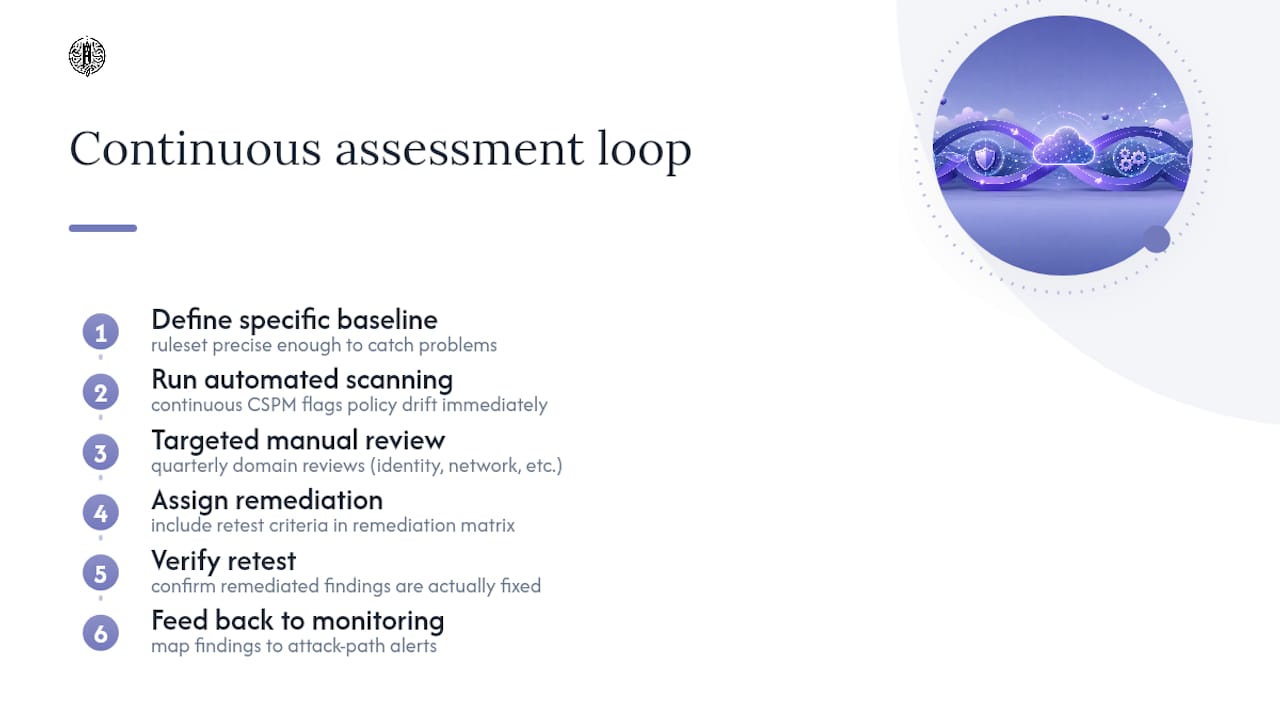
Finally, tie monitoring alerts to the same attack-path logic used in the original assessment. An alert that fires on a low-value misconfiguration gets ignored after the third false positive; an alert tied to a finding that maps to a real exploit chain gets attention.
Roles and Responsibilities in a Cloud Security Assessment
An assessment fails when everyone assumes someone else owns a task. Clear role assignment up front prevents that.
The security or assessment lead owns scope definition, evidence review, and the final prioritization call. This person, whether internal or an outside advisor, is responsible for translating raw findings into an attack-path narrative that decision-makers can act on. Cloud infrastructure and platform engineers own the technical evidence: pulling CSPM exports, granting read access to logs, and explaining why a configuration exists the way it does before anyone labels it a finding.
Compliance and governance staff bridge the assessment to existing frameworks, mapping findings against CCM domains or NIST baselines and flagging where a finding also triggers a regulatory obligation. Executive sponsors, typically a CISO or VP of engineering, own resourcing decisions: approving the time and budget the remediation matrix requires and breaking ties when two teams disagree about priority.
Remediation owners, assigned per finding rather than per team, carry the actual fix through to completion and retest. Vague ownership (“the platform team will handle it”) is the single most common reason remediation matrices stall for months. Naming one person by name, with a due date, changes that dynamic immediately.
External assessors, when used, contribute independence and pattern recognition from having seen the same misconfiguration across many environments, but they still depend on internal staff for access, context, and the institutional knowledge of why a system was built a certain way.
Challenges and Limitations of Cloud Security Assessments
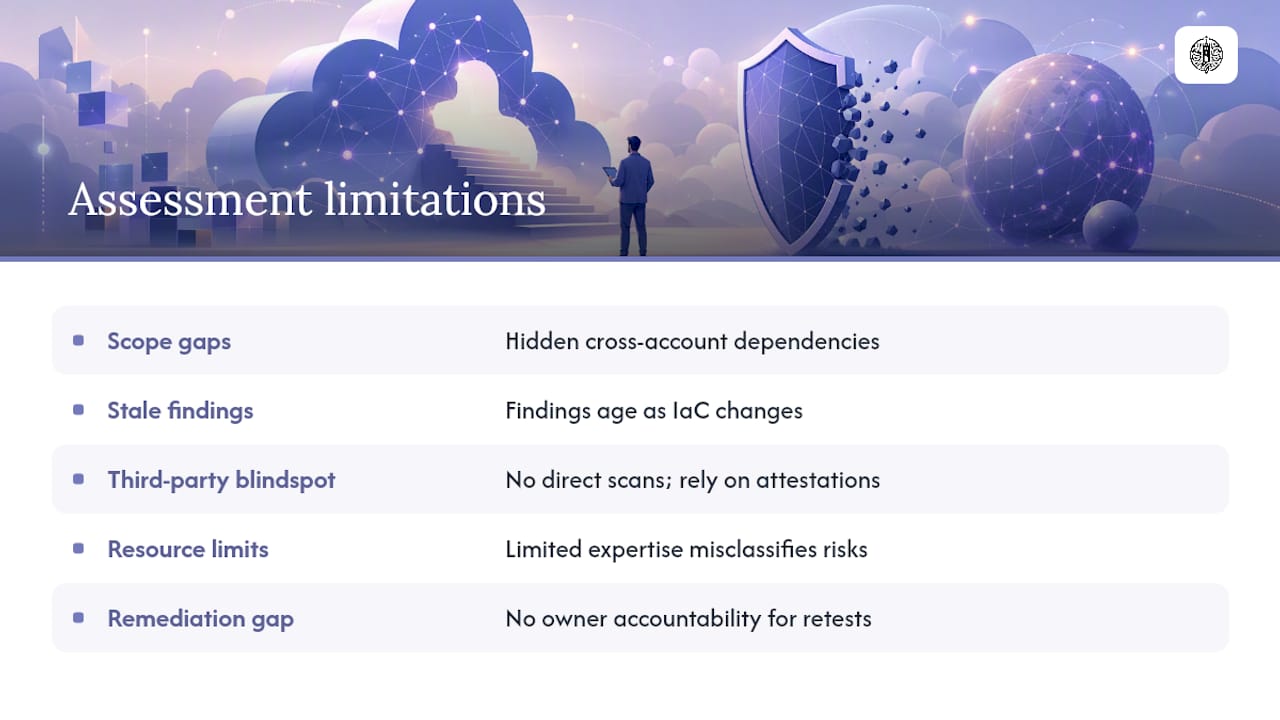
No assessment produces a complete picture, and pretending otherwise sets up false expectations. The most common limitation is scope creep in the opposite direction: reviewers scope an assessment to a single account, only to discover mid-review that critical dependencies live in a second account nobody flagged during planning.
Point-in-time findings age quickly in an environment where configurations change daily through automated pipelines. A finding accurate on the day of the review can be technically outdated within weeks if the underlying infrastructure-as-code template gets modified again, which is exactly why continuous monitoring has to pick up where the periodic assessment leaves off.
Third-party and SaaS layers create a visibility gap that direct testing cannot close. When an organization cannot run its own scans against a vendor’s infrastructure, assessors have to lean on attestation reports, provider interviews, and self-assessment questionnaires instead of firsthand evidence, and that secondhand evidence is only as strong as the vendor’s own audit discipline.
Resource and expertise constraints limit depth in smaller organizations. A team with no dedicated cloud security specialist may be able to run a CSPM scan but lack the context to distinguish a genuine attack path from a low-risk configuration flag, leading to either alert fatigue or missed severity.
Finally, remediation follow-through remains the hardest limitation to solve with tooling alone. An assessment can produce a perfect prioritized roadmap and still fail if no one holds owners accountable for the retest date. The technical work of finding problems is, in practice, often easier than the organizational work of getting them fixed.
The Part of Cloud Security Assessments Everyone Underrates
The technical rigor of a cloud security assessment gets most of the attention: which CSPM tool, which framework, how granular the IAM review goes. That focus is reasonable, but it misses where most assessments actually fail, which is not in the finding phase at all. It is in the gap between a finished report and a completed fix.
Conventional advice treats remediation as a downstream administrative task, something that happens automatically once findings are documented well enough. That assumption does not hold up. A remediation matrix with clear owners and due dates still stalls when nobody has the standing, or the communication skill, to push back on competing priorities and get a fix scheduled against a sprint that is already full.
The judgment this article’s research actually supports is narrower than most assessment guides admit: attack-path prioritization and framework mapping determine whether a finding gets taken seriously, but organizational clarity determines whether it gets fixed. Teams that pair rigorous technical evidence with named ownership and a system for tracking status close far more findings than teams that produce a better report and stop there. Prioritize the handoff as much as the audit itself.
— Jesse Hart
Get Started With a Technical Systems & Risk Review
PROJECT-JTH runs cloud security assessments the way this article describes them: evidence first, attack paths mapped, and a remediation matrix with named owners instead of a findings list that sits in someone’s inbox. The Technical Systems & Risk Review covers the identity, exposure, and governance domains outlined above, paired with Infrastructure Automation & Ansible Review when infrastructure-as-code drift is part of the problem.
An initial scoping call establishes account and workload boundaries, confirms which evidence you can provide versus what needs direct access, and sets a realistic timeline before any work begins. Organizations that want ongoing structure for engagement models can review the Solo, Team, and Practice plans, and teams that need a system for tracking remediation owners after the report lands can start with Project Relay. Reach out through the technical consulting page to schedule that first conversation.
Sources
FAQ
What Are the Six Pillars of Cloud Security?
Definitions vary slightly across vendors, but the version practitioners use most often covers identity and access management, data protection, network security, workload and compute security, logging and monitoring, and governance or compliance. A cloud security assessment checklist built around these domains, expanded to include containers and backups, gives a more complete practical picture than the six-pillar shorthand alone.
What Are the Three Main Types of Security Assessments?
The three common types are vulnerability assessments, which scan for known technical weaknesses; penetration tests, which actively attempt to exploit those weaknesses; and comprehensive security reviews, which combine automated scanning, configuration analysis, and framework mapping into a full posture review. A cloud security assessment typically falls into that third category, since it evaluates configuration, identity, and governance together rather than testing a single attack vector.
What Are the Four Types of Cloud Security?
Cloud security is usually broken down by deployment model: public cloud, private cloud, hybrid cloud, and multi-cloud, each carrying different shared-responsibility boundaries and exposure profiles. A cloud security review has to adjust its scope and evidence-gathering approach based on which model, or combination of models, an organization actually runs.
What Is the Best Certification for Cloud Security?
No single certification fits every role, but the CCSP (Certified Cloud Security Professional) and CSA’s CCSK (Certificate of Cloud Security Knowledge) are the two most widely recognized for assessment-focused work, alongside cloud-specific paths like AWS Certified Security or Azure Security Engineer for practitioners working primarily in one platform. Organizations hiring for a cloud vulnerability assessment role often look for a combination of one broad certification and one platform-specific credential rather than either alone.
How Much Does a Cloud Security Assessment Cost?
Pricing depends heavily on scope, the number of accounts involved, and whether the engagement includes remediation support alongside the initial review. PROJECT-JTH’s Technical Systems & Risk Review pricing is available directly through the technical consulting page after an initial scoping conversation establishes the size of the environment.
